
It's about time
I have always been conscious about how I spend my time, but never more so than the last few years.
Currently, my life exists in the overlap of three distinct worlds: working as a contract developer, solo-developing a complex SaaS, and renovating a 250-year-old French millhouse. Balancing these while trying to maintain a healthy amount of time for family, exercise, and friends is ... challenging. Multi-tasking an audiobook on team taxonomies while lime rendering a stone wall, or jaggedly noting down half-forgotten to-dos on the treadmill, has become my everyday.
The Friction of Modern Tools
To manage this, I tried to bring over my professional experience in project management. TL;DR: it wasn't a positive outcome. Hot-swapping between hour-tracking and Kanban/Gantt charts added friction but had no measurable improvement on outcome.

Truth is, I've always held a bit of grudge against the time track/project plan SaaS-sphere. The former felt tedious, an overwatch that was necessary (billing) but hollow. Project planning meanwhile has always registered as optimistic half-truths and unvetted, unproven opinion. Necessary work ... I mean, there has to be some oversight ... but inevitably it always degraded over time into "the place where the tasks live".
A problem that needed solving, but never one I thought to solve myself. Until it became personal.
work Becomes Work
I started small. The initial task felt small (ha!). I wanted a time tracker that didn't hide "26 hours of lime rendering" in an uncollated mass of descriptions. "Something that doesn't just throw them in a bucket" was the chalk scribble in my mind. That quickly expanded into the need for tracking time against actual tasks. Not just high-level "Renovations - All" buckets that always become troughs, but specific tasks. "Hrm, Epics would also be nice," I thought, and the scope creeped along.
Optimism Becomes Reality
6 months in, and the Kanban had emerged. Todo: buy lime. Doing: back wall. Roof beams rotted. Blocked! New Epic! Done! The code flowed like I was a college student who'd just discovered Code Red because the stakes were personal and the results felt immediate. Applying hours against specific tasks was liberating, but the old drudgery of dragging stuff around was back.
Then, epiphany. (likely while covered in itchy lime dust). Manual grooming of the board was unnecessary. Why was I dragging the task from todo to doing, then logging the first time entry against it? They were the same thing.
The core differentiator of AbleTime was born. Suddenly everything could be automated. I added a Gantt chart, a "timeline" of optimistic planning that I could anchor with real hours. Scheduled on Tuesday, but a work deadline pushed it to Saturday. When I started the timer, the Gantt bar moved invisibly in the background, a ghost bar covering those 4 days to remind me of what I'd planned vs. what actually happened. Velocity updated, pressure bumped, but it was immediately visible and I could adapt my schedule to match.
Tracking the Work
Fast forward a year, and AbleTime is now a fully-realized time-bound project planner. Every hour is accounted for. Overhead, a thing that most other applications ignore, is now front-and-center. You can’t judge capacity if you’re ignoring the 'small-w' work. Meetings and admin aren't just noise; they are the context in which your 'Big-W' Work happens. AbleTime treats them with equal respect.
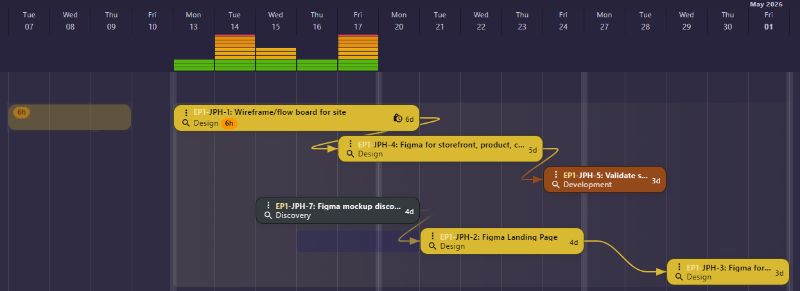
Backlog too. The hidden sin of "task RTW-123 was in planning for 12 hours ... shhhh" now appears on the Gantt as a muted-but-knowing "that which was once hidden is now seen".
The Kanban ... I call it the Flow Board, because that's what the work does now ... is a visual register of exact status, not a "behind-never groomed" afterthought. The Timeline (Gantt) is my truth board, every hour exposed/automated/honest. There's Epics, automated billing, tags and stages for your tasks to flow through, dashboards and reports and ... well, a lot more.
All of it revolves around the simple effort of tracking your time. The rest you can take or leave, since most of it takes care of itself anyway. Invest yourself entirely, or take it slow and explore at your own pace. Either way works.
AbleTime, at the time I write this, is in closed beta. No commitments, no CC required, just 60 days of freedom to see if it works for you too. Visit abletime.com and add your name to the invite list.
— Grant Shepert is the founder of AbleTime; life currently finds him coding, writing, and occasionally renovating in the north of France.

