Dogfood
Today, not a single hour of my workday passes without some kind of interaction with AbleTime. In fact, every hour probably sees a dozen or more. It existed as a working product for almost a year before I started using it, and I regret that, because it has become indispensable.
Yes, that probably reads as a pitch ... and it probably is a bit, but it comes from a place of honest fact.
Focus
It has become my attention guru. As a work reference, it holds all my tasks and their states, and at any one time there are at least several dozen things vying for my attention, tickets and feature builds and documentation gaps and content deadlines and ... you get it. A lot. So every morning I say "give me a list of the priorities" to my self-configured AI assistant. It "MCP"'s (Model Context Protocol, in verb form) into my riot of distractions and demands and picks out the top four or five based on recent + priority, and I pick one. The ticket list would overwhelm me pre-coffee, but using the "pull" methodology means I can focus without panic.
Time Spent
As soon as I start, it starts tracking my time against the task ... unasked. That's the model as designed, a quiet time tracker that I just take for granted. And not just time. Every effort against the work is also recorded. Write a plan, that plan goes into the task. Run a validation, recorded. Build, revise, commit, refactor ... everything recorded without a single prompt or reminder. If something goes awry, I can look back two weeks later and pinpoint why.
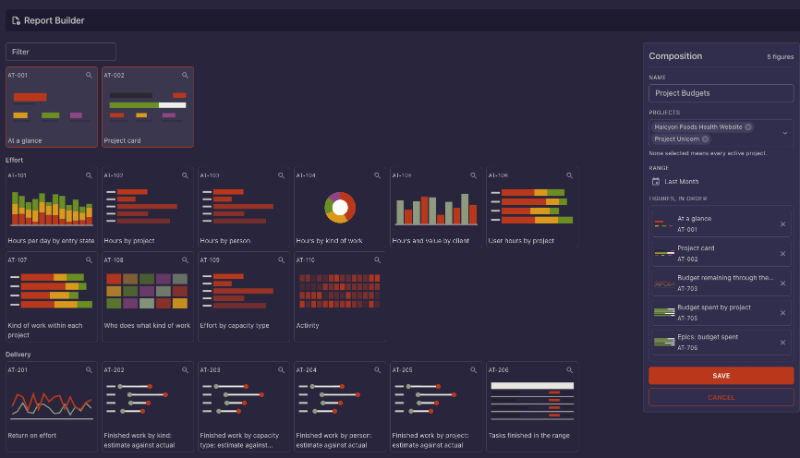
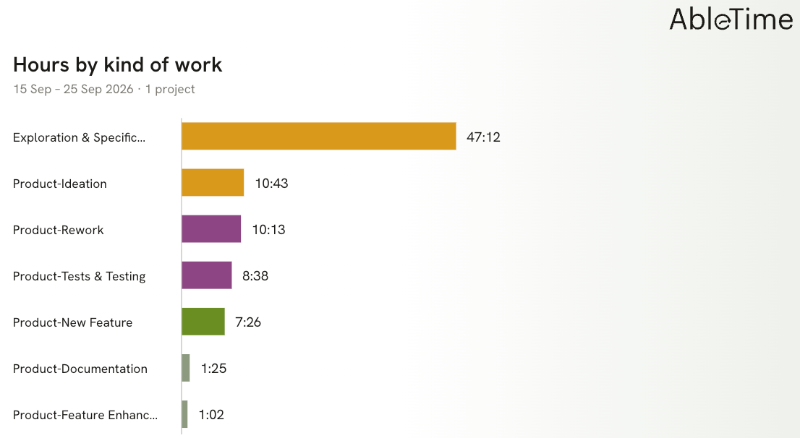
A good example is our most recent feature, "Intelligence Reports", a custom reports builder accessible via agent prompts or configuration. Asked to guess, I'd have put my "Exploration" at around 10-20% of my time. In reality, it was over 50% (see the masthead image). Development used to be all concentrated in the middle, now it's lead in (specification/prototype) and testing/rework. Seeing it is core to understanding it, and has crushed my mental model of where I thought my time was concentrated.
Whether a sole operator or part of a team, this kind of record is critical to managing and refining your workflow.
Issue Discovery
As a solo dev, things slide off the desk or get buried in the pile. With AbleTime, I've instructed my agents to "log every single issue you encounter, out of scope or not, as a ticket" (more on this later). The hateful beast does as ordered, and tickets accumulate that would otherwise go unnoticed or forgotten. This alone makes the tool invaluable.
Instead of getting distracted, agents log the ticket and move on. Scope creep, assumption and guessing are AI agent kryptonite. They are also goal-oriented. Writing the ticket essentially dissolves any accumulated fractions of distraction they would otherwise absorb, because for them the "issue" and "write-a-ticket" solution are a closed loop.
As a part of a team, it means you get a full understanding of what, where and why things are the way they are. You don't need a standup to tell you where everybody is, or wait for them to log time to gain perspective, because the record is automated. A simple query to an agent gives me full, accurate-to-the-moment accounting of project status.
Privacy!
If "Eeek privacy!" is your gut reaction, I get it. Which is why the ledger is split. Tasks, whether tickets or workflow items, are always recorded. It's the work, and everybody needs to see it. Time entries are the other side of the coin, and I drew a hard line there when it came to privacy. Agents can only ever record drafts. They literally do not have the ability to log org-visible time entries. They sit in a detached table, waiting for my review and approval.
Efficiency!
As an
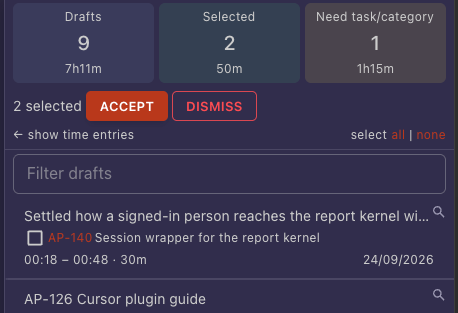
ardent time-tracking hater (yes, you read that right), I always found the process of "time track archeology" an annoying, tedious, irritating and annoying (worth saying twice). With drafts, all the hard graft is already done. What I do is review what landed, and that experience is insightful instead of drudgery. The "draft review" panel replaced the frustrating email/Slack/git/task archeology with click > review > accept/dismiss.
Workflow
As I said, I use the "pull" methodology, which is drawn from Taiichi Ohno's Kanban philosophy of one in, one out. I've adopted a pretty agentic-first workflow, having learned all the hard lessons over the last few years and adapted them from an "engineering is the heavy work" into "validation and testing is the heavy work".
AbleTime's Flow Board has become my everyday workflow monitor. When a task or series of tasks is performed by an agent, it shifts from "to-do" to "doing" to "validate" to "certify" automatically. There are other stages too that match my personal preferences, like "stuck" or "rework", but every one of them is designed to tell me, at a glance, where the work is at. Certify is where I spend a lot of time, paging through code, running tests, comparing reports and output, and manually validating what has landed. Without a rigorous workflow pipeline, mistakes would slip through often.
Ticket Master
As I mentioned, I've instructed agents that discover lateral, out-of-scope issues to write a ticket and move on. That's only half the battle.
I also have a cloud agent monitoring AbleTime logs, and every new issue gets automatically logged into the "Issues" project. Each is classified by type and priority, and a second agent run does all the research, using "notify" to let me know if anything serious ever appears. For the very small stuff, a third run does clean-up, logging the work and creating pull requests that land in my "certify" lane.
I now have a process that gives me awareness, self-heals and performs housekeeping. None of this is magical or hacked together; it just falls out naturally from the combination of agentic AI and AbleTime being able to speak via MCP.
Knowing What You Don't Know
Reporting is the final superpower that I'm going to cover, and it is a big subject and the core of what AbleTime brings to the table. Unlike many modern project management tools, AbleTime tracks both time and tasks as "first-class", i.e. each is treated as core and bound tightly to the other. This is critical to understanding work, because effort is the sole currency we spend to complete tasks. Without tightly matching one to the other, we introduce guesswork and assumption into how efficient we are.
The fact that I can identify with precision how much time was spent building "Intelligence Reports" or "MCP Plugins for Cursor" is core to me understanding what each feature costs, how good (or bad) my estimate is of how long a thing takes to build, and how I can make decisions going forward.
Devs are notorious for using terms like "easy" or "quick" to describe the effort that goes into building something, and I am no different. But "easy" usually means "there is no lab work or blue-sky involved," not "it's 10 minutes' work". "Quick" is usually us thinking in idea-to-prototype terms, which in modern agentic is usually only a few hours away, no matter the scope. But prototype does not equal product. Ideation, iteration, scope creep, validation, documentation, rework, more scope creep, more iteration and lots more testing and validation ... it all adds up in dribs and drabs that turn "easy" and "quick" into "complex" and "arduous".
With AbleTime, I can run reports that give me fine-grain insights, down to the minute, no matter how many tasks the work is spread across. If the pre-configured reports (of which there are ~50 now) can't cover it, the cleanly aggregated data underlying them can be built into a very accurate custom report by an agent.
My Workflow
The irony of this rather long blog post is that it only covers part of what I use AbleTime for now. I've used it as an AI agentic orchestrator, where Flow Board stages act as control gates and triggers. I have specialist agents run reports against it on a daily basis and send priority task notifications to my Slack channel. In the future I'll probably break down some of these, but suffice it to say, even I haven't exercised or discovered the full potential of AI + AbleTime as a work surface.
For many months I never used AbleTime as a consistent part of my workflow, and I regret that. The addition of MCP and agents got me on the path, and now I can't imagine a day without it.
— Grant Shepert is the founder of AbleTime; life currently finds him coding, writing, and occasionally renovating in the north of France.